Private and On-Prem AI: When It Makes Sense and When It Does Not
Running AI inside your own boundary protects sensitive data but adds cost and operational weight. A practical way to decide, workload by workload.
Three deployment models, not two
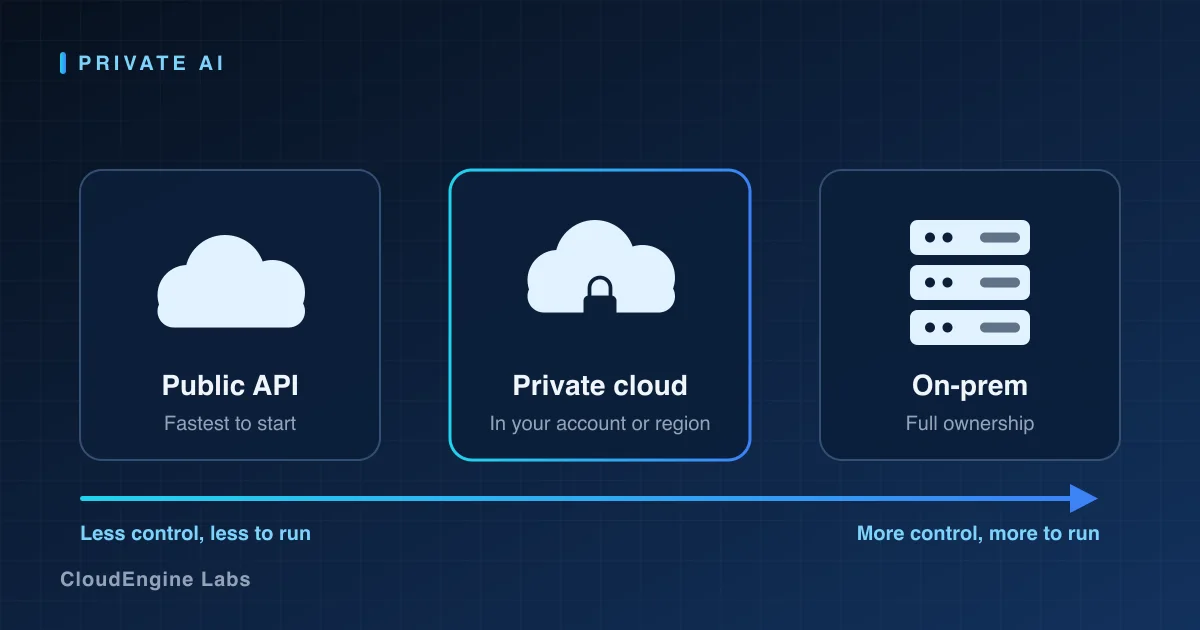
The debate is usually framed as public cloud AI versus on-prem. In practice there are three common models, plus hybrids of them.
For many regulated workloads, the middle option is enough: a managed model service inside a tightly controlled cloud account, with private networking, access controls and audit logging.
- Public model API: fastest to start, but prompts leave your environment.
- Private cloud or in-region deployment: models run in your own account or tenancy, in a region you choose.
- On-prem or dedicated private environment: you own the hardware and the full serving stack.
When private or on-prem AI is justified
Choose it when a real constraint requires it, not because it sounds more secure. A hard requirement is a much better reason than a preference.
- Data cannot leave an environment because of law, sector rules or customer contracts.
- You need control over the exact model version, weights and data retention.
- The workload runs in restricted or air-gapped networks.
- Steady, high-volume inference makes owned hardware cheaper over time.
- Latency to on-site systems matters more than elasticity.
What it really costs
The hardware is the visible cost. The less visible costs are the people and processes needed to keep a model-serving platform reliable and secure.
There is also a capability question: the best open models can be an excellent fit for many tasks, but they may not match the largest hosted models for every task, so test with your own data before you commit.
- GPU procurement lead times, power, cooling and capacity planning.
- A model-serving stack that must be patched, monitored and kept available.
- Security hardening, access control and on-call support.
- Idle capacity when demand is lower than planned.
- Evaluation work to prove the model is good enough for the task.
A decision framework per workload
Decide for each workload, then choose the lightest option that meets the constraint. Most organisations end up hybrid.
- Classify the data: public, internal, confidential or regulated.
- State the requirement: residency, jurisdiction, key control or isolation.
- Estimate volume, latency and growth.
- Test candidate models on your own evaluation set.
- Compare three-year total cost, including people and operations.
- Pick the lightest deployment model that satisfies the requirement.
Governance does not come free with the hardware
Hosting a model yourself does not make it governed. You still need access control, an AI gateway, logging, change control for models and prompts, evaluation and an incident process.
Our Sovereign / Private AI Readiness Assessment covers workload classification, deployment-option comparison, target architecture, security and governance controls, and a phased roadmap with a high-level cost view.
Need production guidance for your AI product?
We help teams move from AI-built prototypes to production-ready, secure systems.