Data Sovereignty for AI: What It Means and Why the UAE Prioritises It
Data residency, jurisdiction and control are not the same thing. Here is what data sovereignty means once AI enters the picture, and why the UAE treats it as a strategic priority.
Sovereignty is more than where the data sits
Data residency answers one question: in which country are the servers? Data sovereignty asks a harder one: which laws can reach this data, and who actually controls access to it?
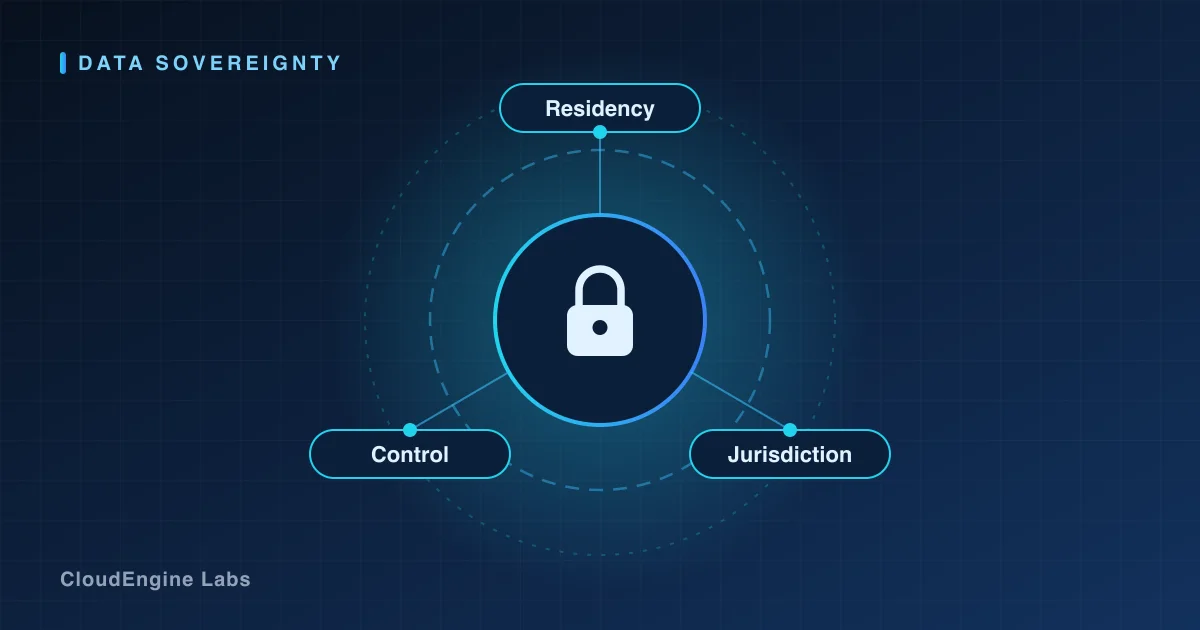
A dataset stored in an in-country region can still be exposed to other legal systems, depending on who operates the platform and what the contracts say. That is why mature buyers ask three separate questions instead of one.
- Residency: where are the data and the processing physically located?
- Jurisdiction: which legal systems can compel disclosure or access?
- Control: who holds the encryption keys, administrator access and operational runbooks?
Why AI widens the surface
A conventional application keeps data in a database. An AI system creates many more copies, and each one is a sovereignty decision you may not have noticed you were making.
If prompts or documents are sent to a third-party model API, you also need to know where that provider processes them and how long it retains them.
- Prompts and model outputs, which often contain customer or employee data.
- Retrieved documents, embeddings and vector stores built from internal content.
- Logs, traces and evaluation sets captured for debugging and quality.
- Fine-tuning data and the resulting model weights.
What the UAE has put in place
The UAE does not have a single data rulebook. The federal Personal Data Protection Law (Federal Decree-Law 45 of 2021) has been in force since January 2022 and includes rules on transferring personal data abroad, although some implementing detail was still being finalised in the sources we reviewed, so check the current position before relying on it.
Free zones run their own regimes. The DIFC has its own Data Protection Law, which added Regulation 10 in 2023 on processing personal data with autonomous and semi-autonomous systems such as AI. ADGM has the ADGM Data Protection Regulations 2021.
Some sectors add stricter rules. Under the federal health ICT law (Federal Law No. 2 of 2019), health data relating to services provided in the UAE generally has to stay in the UAE, subject to exemptions set by regulation.
- Federal law, DIFC and ADGM apply to different organisations, so first work out which regime covers you.
- Health, financial and government workloads may carry additional sector requirements.
- This is general information, not legal advice. Confirm obligations with qualified counsel.
Why governments choose sovereignty
The UAE has linked data policy to a wider national strategy. The National Strategy for Artificial Intelligence 2031 and investment in in-country compute and sovereign cloud platforms show that data control is treated as infrastructure, not only as compliance.
In our reading, several motives sit behind this, and they apply to many countries, not only the UAE.
- Trust: clear rules give citizens and businesses confidence that sensitive data is handled responsibly.
- Resilience: depending on foreign infrastructure for critical services is a strategic risk.
- Capability: owning compute, talent and platforms keeps value and expertise in-country.
- Supervision: regulators can oversee data and organisations they can actually reach.
- Adoption: when the rules are clear, regulated sectors can use AI with confidence rather than wait.
What this means for teams building AI
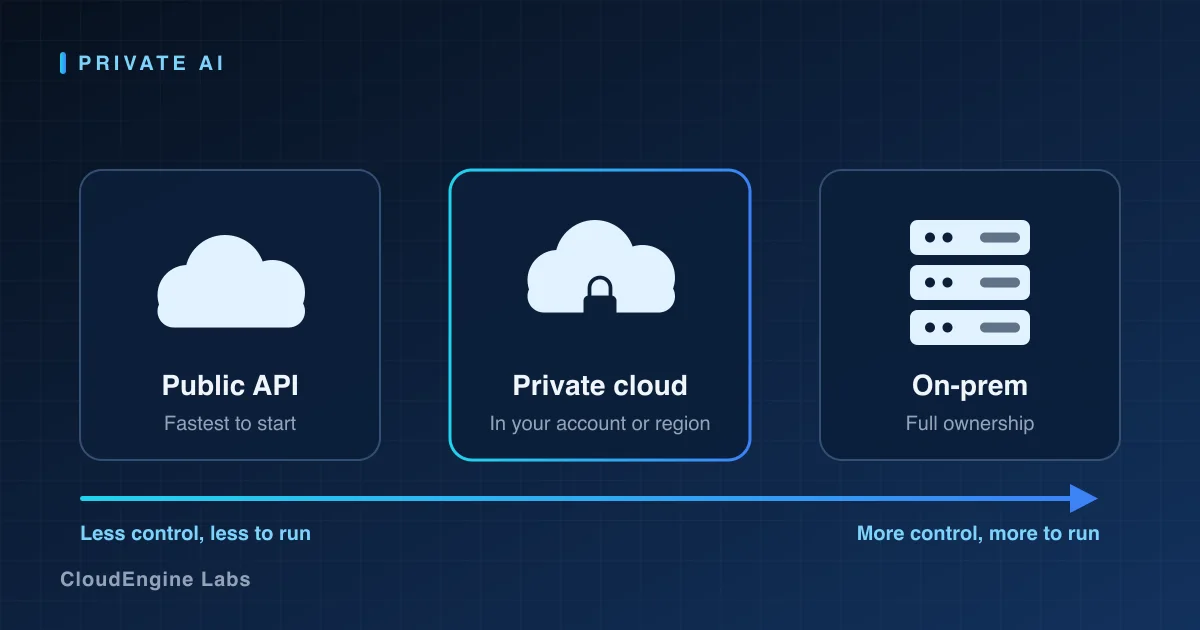
Treat sovereignty as a per-workload decision, not a company-wide switch. Some workloads are fine on a public model API. Others need an in-region cloud deployment, and a few need a fully private environment.
A Sovereign / Private AI Readiness Assessment helps you classify workloads, compare deployment options and build a phased roadmap before you commit to infrastructure.
- Classify your data and map every place an AI workflow copies it.
- Decide residency, jurisdiction and key-control requirements per workload.
- Document the decision so that audits and customer reviews become straightforward.
Need production guidance for your AI product?
We help teams move from AI-built prototypes to production-ready, secure systems.