Why Organisations Need Compliance Engineering Before AI Reaches Production
AI pilots often pass a security review on paper and stall at audit. Compliance engineering turns requirements into controls and evidence built into delivery.
Why AI pilots stall at approval
Security, legal and risk teams ask the same questions of every AI project: where does the data go, who can access it, what is logged, and how are changes approved?
Teams that answer with slides lose weeks. Teams that answer with evidence from their own pipelines get approved faster.
Where the obligations come from
Few organisations answer to one rulebook. Obligations stack up from several sources, and AI adds new ones on top.
This is general information, not legal advice. Which rules apply to you depends on your sector, location and customers.
- Data protection law, such as the UAE federal PDPL, DIFC and ADGM regimes, or India's DPDP Act.
- Sector rules for health, financial and government workloads.
- Customer due diligence: security questionnaires, ISO 27001 and SOC 2 expectations.
- AI-specific rules, such as DIFC Regulation 10 on autonomous systems, and the EU AI Act, which can apply to organisations serving the EU market.
What compliance engineering means
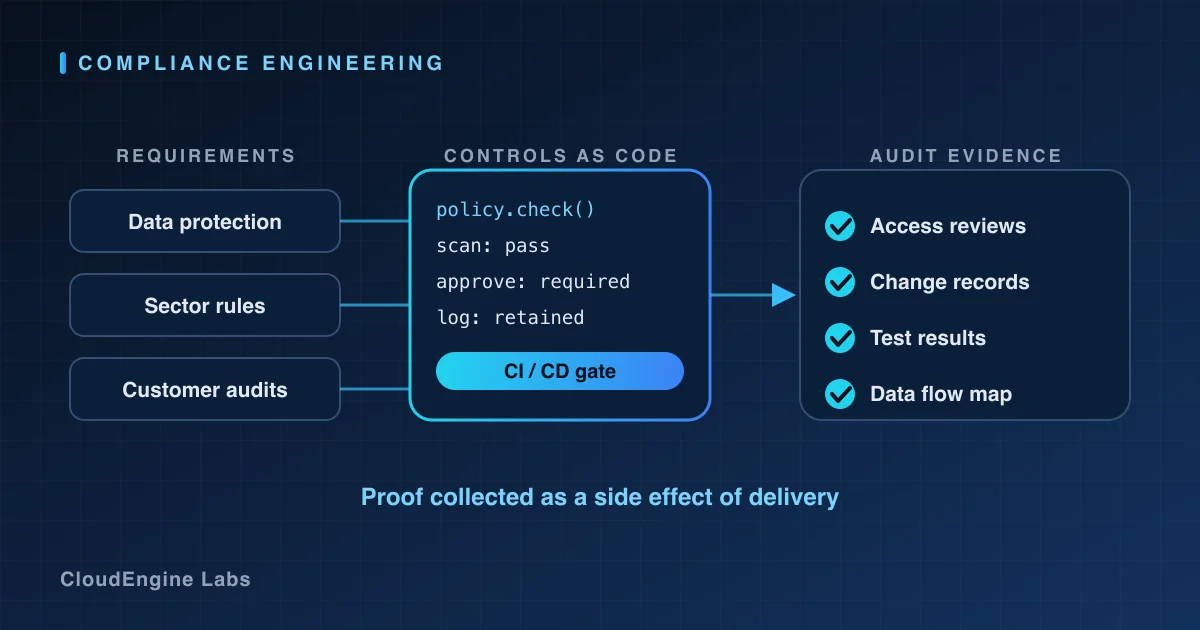
Compliance engineering turns each requirement into a control with an owner, an automated check and a piece of evidence that is collected as a side effect of normal delivery.
It does not replace legal or audit judgement. It removes the manual scramble of assembling proof by hand.
- Control mapping: requirements linked to concrete technical controls.
- Policy as code: scans, approvals and release gates enforced in CI/CD.
- Automated evidence: logs, change records and access reviews gathered continuously.
- AI controls: versioned prompts and models, evaluation records and documented data flows.
What goes wrong without it
Without engineered controls, compliance becomes a periodic event rather than a property of the system.
- Evidence is assembled by hand before every audit.
- Teams adopt AI tools outside any approved path.
- Prompts and models change without a record of who approved them.
- Nobody can draw an accurate map of where data flows.
- Sign-off becomes the bottleneck, so delivery slows down.
A practical starting point
Start small and specific. You do not need every framework, only the ones your buyers and regulators actually care about.
Our AI Compliance & Governance Readiness Assessment follows this sequence and is accelerated by our GovPilot / Attesta tooling. You receive a gap assessment, a risk and control matrix, an evidence checklist and a prioritised roadmap toward audit readiness.
- Map your data and AI flows end to end.
- Choose the frameworks that genuinely apply.
- Run a gap assessment against them.
- Automate the evidence for the highest-risk controls first.
- Build a roadmap toward audit readiness.
Need production guidance for your AI product?
We help teams move from AI-built prototypes to production-ready, secure systems.